Showing posts with label aches and pains. Show all posts

Monday, November 10, 2014

"Step into your own personal power" How To: Listen To Your Body

A wonderful Article from Louise Androliahttp://livetheprocess.com
We are in a glorious, openhearted world for wellness. Around every corner, there is a juice bar and a yoga center. There are endless classes, podcasts and therapies to experience; bookshelves and blogs are filled with recipes and plans to follow.
The time really is now, but it’s also, for a lot of people, totally overwhelming. My clients often arrive in a state of total disconnect from their mind, body and spirit, especially when it comes to their own physical health. In regards to eating habits, they are either in a state of confusion about what the “correct” way to eat is or they perceive themselves as failing if they have trouble sticking to a diet that was chosen, for example, because it’s on trend.
In order to make the most of the incredible time in which we live, we all need to take a few steps back and reconnect to ourselves.
It doesn’t matter what everyone else is doing; it doesn’t matter how great the latest health trend may be. If it doesn’t align with you, then it’s not for you. So, before you get confused by the holistic banquet, here’s how to reel yourself back in. After all, feeling good is more important than fitting in.
1. Be Positively Selfish
This is a term I use often to teach clients to put their own wellness at the top of their list. When you value your health, everything else can function a lot better underneath that one golden rule. To be selfish about your wellbeing means to remember that your experience is unique. Yes, our body systems are alike, but it makes no sense to try to copy and paste someone else’s individual body code onto your different make-up. For instance, I look after myself with my autoimmune condition in mind. That’s of course going to be different for someone who has a different set of symptoms.
Step into your own personal power and choose to conduct your life with one goal: that you feel good. With this in mind, you can start to work with your body.
2. Tune into your body
A great first step is to acknowledge all your physical, mental and emotional conditions and symptoms, both longterm and those that are new. When you choose to tune into your physical body, it’s amazing how powerfully it speaks to you. You can ask yourself all sorts of questions, such as:
1. How do I feel right now?
2. What aches and pains have become regular to me?
3. How do I sleep and how do I feel when I wake up?
4. How do my energy levels and mood change throughout the day?
5. Am I aware of my own stress levels?
6. How often do I pretend to be fine?
You can also practice a moving meditation with eating. When you have breakfast, sit without electrics or distractions and only the meal in front of you. As you take each mouthful, feel the food, its temperature, its texture and how it feels going into your body. This connects you not only to your body, but also to the present moment.
3. Listen to your body
You may now be more present and aware of the ways in which you feel off-balance. To combine these steps together, start a wellness diary for a few weeks. Write down everything you eat, the exercise you do and a brief description of your day. Alongside, note down your stressors and your physical, mental and emotional symptoms, including hormonal cycles.
4. Take Action and Nurture Your Journey
Now you can make the most of this bright time we are in! Armed with the knowledge of what it feels like to be you, it’s much easier to see which books, therapists and blogs you relate to and also to know whether they work for you or not. You also have a diary that you can take to a doctor or nutritionist. Instead of just feeling “unwell” or “tired,” you might be able to pinpoint what lead to that specific feeling.
Finally, be compassionate to yourself and your journey. A common block I see is when we devalue what we are feeling or experiencing. It’s so easy to say that we are “fine” or tell ourselves that we are probably just being silly. If you are having a feeling in your mind, body or spirit, then it is valid and it is yours to nurture.
Learn about your own body, then embrace the empowerment that comes from utilizing the wealth of tools and information that surrounds you.

Tuesday, October 7, 2014

6 Exercises to Reverse Bad Posture

Did you know that for every inch the head moves forward in posture, its weight on your neck and upper back muscles increases by 10 pounds?
For example, a human head weighing 12 pounds held forward only 3 inches from the shoulders results in 42 pounds of pressure on the neck and upper back muscles. That's the equivalent of almost three watermelons resting on your neck and back!
When you neglect your posture, you invite chronic back pain. Rounding your low back while sitting for extended periods of time in front of a computer, standing for hours stooped over, sleeping improperly and lifting poorly can all lead to debilitating aches.
Maintaining the natural lumbar curve in your low back is essential to preventing posture-related back pain. This natural curve works as a shock absorber, helping to distribute weight along the length of your spine. Adjusting postural distortions can help stop back pain.
A basic remedy to sitting all day is to simply get up! Frequently getting up from a seated position and doing these six quick and easy realignment exercises can help you reeducate your muscles from getting stuck in a hunched over cave man position.
1. Chin Tuck
The Chin Tuck can help reverse forward-head posture by strengthening the neck muscles.
This exercise can be done sitting or standing. Start with your shoulders rolled back and down. While looking straight ahead, place two fingers on your chin, slightly tuck your chin and move your head back (image at left). Hold for 3-5 seconds and then release. Repeat 10 times.
Tip: The more of a double chin you create, the better the results. If you’re in a parked car, try doing the Chin Tuck pressing
the back of your head into the headrest for 3-5 seconds. Do 15-20 repetitions.
2. Wall Angel
Stand with your back against a flat wall with your feet about four inches from the base. Maintain a slight bend in your knees. Your glutes, spine and head should all be against the wall. Bring your arms up with elbows bent so your upper arms are parallel to the floor and squeeze your shoulder blades together, forming a letter "W" (image at left). Hold for 3 seconds.
Next, straighten your elbows to raise your arms up to form the letter “Y.” Make sure not to shrug your shoulders to your ears. Repeat this 10 times, starting at “W,” holding for 3 seconds and then raising your arms into a “Y.” Do 2-3 sets.
3. Doorway Stretch
This exercise loosens those tight chest muscles!
Standing in a doorway, lift your arm so it's parallel to the floor and bend at the elbow so your fingers point toward the ceiling. Place your hand on the doorjamb.
Slowly lean into your raised arm and push against the doorjamb for 7-10 seconds. Relax the pressure and then press your arm against the doorjamb again, this time coming into a slight lunge with your legs so your chest moves forward past the doorjamb for 7-10 seconds (image at left). Repeat this stretch two to three times on each side.
4. Hip Flexor Stretch
Kneel onto your right knee with toes down, and place your left foot flat on the floor in front of you.
Place both hands on your left thigh and press your hips forward until you feel a good stretch in the hip flexors.
Contract your abdominals and slightly tilt your pelvis back while keeping your chin parallel to the floor (image at left). Hold this pose for 20-30 seconds, and then switch sides.
The next two exercises require a resistance band:
5. The X-Move
This exercise helps strengthen your upper back muscles, especially the ones between your shoulder blades (the rhomboids).
Sit on the floor with your legs extended forward. Place the middle of the resistance band around the bottom of your feet and cross one side over the other to form an "X".
Grasp the ends of the band with your arms extended in front of you.
Pull the ends of the band toward your hips, bending your elbows so they point backward (image at left). Hold and slowly return. Do 8-12 repetitions for three sets.
6. The V-Move
According to a 2013 study by the Scandinavian Society of Clinical Physiology and Nuclear Medicine, performing this simple resistance band exercise 2 minutes a day, five times a week, will significantly decrease your neck and shoulder pain and improve your posture.
While standing, stagger your feet so one is slightly behind the other. Grasp the handles, or the ends, of the resistance band and lift your arms upward and slightly outward away from your body about 30 degrees.
Keep a slight bend in your elbows. Stop at shoulder level; hold and return.
Make sure to keep your shoulder blades down and back straight. Repeat this exercise for 2 minutes each day, five days a week.
Good work!

Thursday, June 20, 2013

10 THINGS PEOPLE SHOULD KNOW ABOUT CHIROPRACTIC CARE


1. Pain is the last symptom of dysfunction.
A patient’s back is often restricted or unstable for months or years before it presents as a problem and they show up in a chiropractor’s office. In addition, the absence of pain is not health. While medication may be needed, if you take a pill and the pain goes away, the dysfunction that caused it still persists. Muscle, ligament and joint injuries often occur as a result of long-term biomechanical dysfunction, sometimes from past injuries, making the area more susceptible to future injury.
2. Athletes use chiropractors to stay well and perform better, not just for the occasional injury.
Athletes choose chiropractors because we are movement specialists. Chiropractors were spotted all over the Olympic coverage last year, and top athletes such as Michael Jordan, Tiger Woods, Michael Phelps, Tom Brady, Evander Holyfield, and Arnold Schwarzenegger have all been proud patients of chiropractors. These days it’s far more common than not for major athletes and sports teams to keep chiropractors nearby to help prevent injuries, speed injury recovery, improve balance and coordination, and give them a greater competitive edge.
3. The body does not perform as a cluster of separate mechanisms, but rather a cascade of events that all starts with proper control by the nervous system.
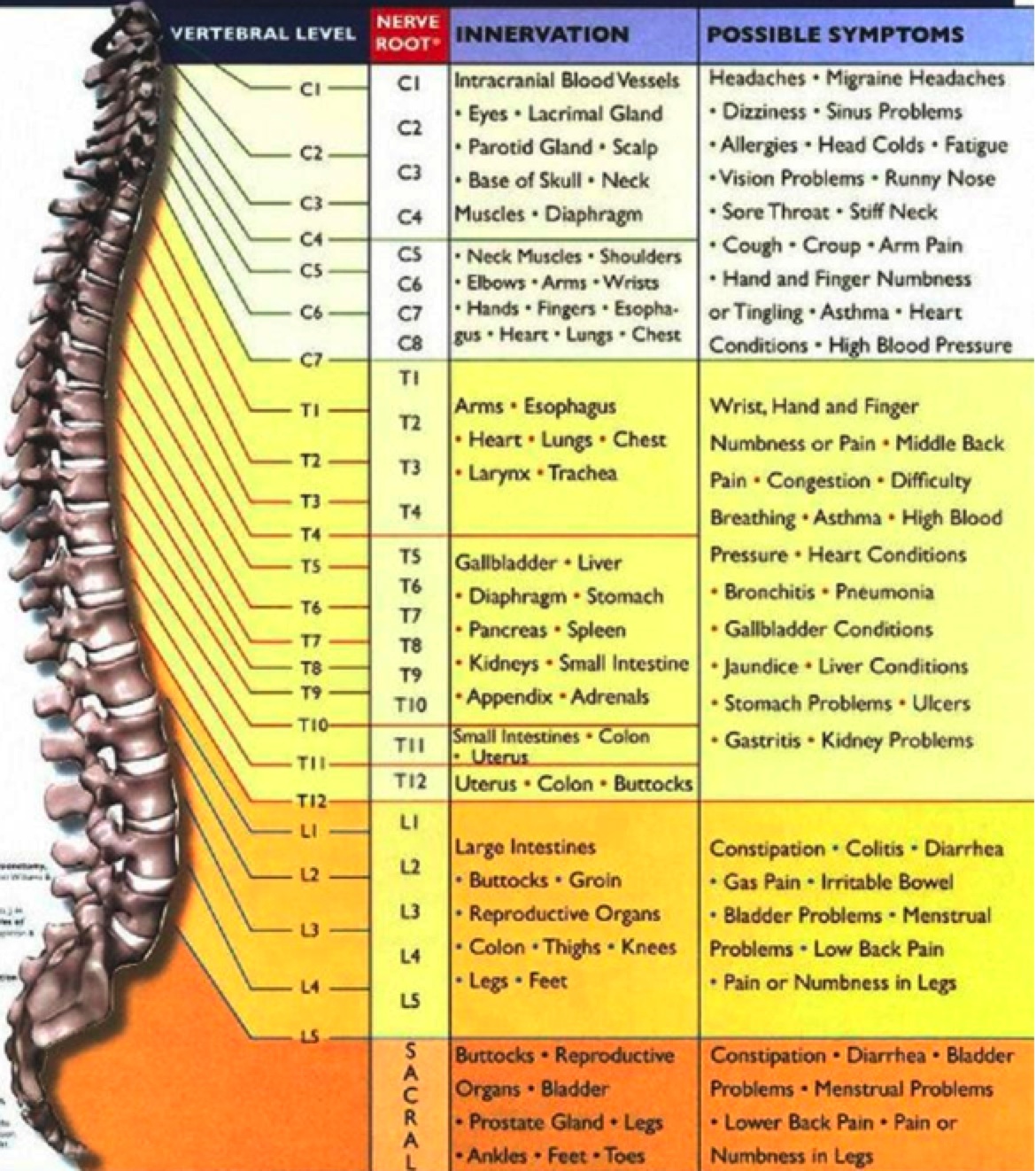
The nerves that travel through and control every function of your body originate at the spinal cord and their transmission may be disrupted if the joints of the surrounding spinal column are not moving properly. This disruption in biomechanical integrity combined with altered physiological function is what chiropractors call a subluxation. Below is a chart that illustrates the relationship of the spinal nerves exiting the vertebra branching off to the various organ systems. You can see why it is not uncommon for a chiropractor to treat a patient with mid-back pain who also suffers from irritable bowel system, a patient with a subluxated sacrum who has been unsuccessfully trying to become pregnant, or a patient with an upper back fixation and acid reflux.
10 Things Most People Dont Know About Chiropractic
4. Doctors don’t do the healing.
Sorry to disappoint you, but a chiropractor will never fix your back. What we are able to do is restore proper motion in the joints, which relieves tension on the nerves and muscles and allows your body to do the healing that it is inherently made to do. As chiropractors, we believe that the body is a perfect organism in its natural state, and all disease comes from a disruption in the body’s proper transmission of signals by the nerves which affects its ability to heal and to defend against disease-causing agents. We never treat disease. We assess to find which spinal levels are causing the disfunction, and we adjust it to restore proper nerve flow so the nervous system may work as efficiently and effectively as possible.
5. Chiropractic is for all ages.
Many seniors aren’t aware of the benefits of chiropractic care which can help them not only with pain relief, but also increase range of motion, balance and coordination, and decrease joint degeneration. There’s no patient too young for chiropractic either! Chiropractors check infants moments after birth for misalignments of the upper vertebrae that may occur as a result of the birth process. In addition to supporting overall health and well-being, parents also take their children to chiropractors to encourage healthy brain and nervous system development, to assist with colic, asthma, allergies, bed-wetting and sleeping problems, and to assist with behavioral disorders.
6. We know about more than your backbone!
This surprises many people who had no idea that chiropractors give advice on nutrition, fitness, ergonomics and lifestyle, screen for conditions unrelated to the musculoskeletal system and refer out to other practitioners when necessary. Chiropractors are also able to complete specialties in other areas such as pediatrics, sports rehabilitation, neurology, clinical nutrition, and addictions and compulsive disorders.
Other than particular specialties and the differences in learning to adjust and learning to prescribe medication, our training hours are not dissimilar from that of medical doctor. The following are the classroom hours for basic science requirements compiled and averaged following a review of curricula of 18 chiropractic schools and 22 medical schools.
10 Things Most People Dont Know About Chiropractic
7. Successful chiropractic patients accept responsibility.
When somebody says that they tried chiropractic and it didn’t help, I cringe and get the feeling that they really missed the boat. Of course, there are cases with complicating factors, but I have heard this from people with straightforward chiropractic problems when it is very clear what has happened here. In most cases, one doesn’t acquire back pain over night, and it’s not going to go away over night. If a weak core from years of sitting at your desk is to blame for the additional stress on your joints, I would expect an adjustment to provide relief, but once the condition is no longer exacerbated, I would most definitely prescribe some exercises for you to do at home. I might also suggest we evaluate your nutrition if I suspect an inflammatory diet may be wiring you for pain. Sure, I’m always happy to adjust someone and make a living, but if you’ve been given homework and you don’t do it, I better not hear you say chiropractic didn’t work when you’re hurting again!
8. Chiropractic may help you get sick less.
Studies have indicated that adjustments consistently reduce the production of pro-inflammatory mediators associated with tissue damage and pain, and may also enhance the production of immunoregulatory complexes important for healthy immune system defense. As far back as the deadly flu pandemic of 1917-1918, chiropractors noticed that their patients seemed to have fewer fatalities than among the general population and were able to publish their work in an osteopathic journal since no scholarly journals were accepting chiropractic data. The estimated death rate among patients of conventional medical care in the U.S. was estimated at 5 to 6 percent while the fatality rate among influenza cases receiving spinal adjustments was estimated at 0.25%.
9. “I heard I’ll have to go forever” is a myth.
You may want to go to your chiropractor forever once you’ve started because you didn’t realize how great getting adjusted is, but your doctor won’t expect you to come for continuous care without symptoms. Generally, if you come in with pain, once you’ve been treated for your initial complaint, you’ll be scheduled for a few more appointments to make sure proper motion is being maintained, then it will be recommended you return occasionally to be checked just like you would go to the dentist to get checked for tartar buildup and cavities. Of course, many people still choose to see their chiropractor weekly or monthly for wellness or maintenance care.
10. Adjustments don’t hurt.
There is no bone snapping or warrior-style pulling heads off spinal columns! The neck adjustment some chiropractors use causes anticipation for many new patients, but is actually much more gentle than they imagined, and involves a quick, direct thrust to a specific spinal bone. The sound an adjustment makes is called a cavitation and is only space being created within the joint causing gasses to be released from the joint capsule, which creates the popping or cracking noise. Also, chiropractic adjustments will not wear out your joints, as some imagine because they have been warned not to “crack their knuckles” for this reason in the past. Adjustments, unlike “knuckle cracking” or having your friend stomp on you while you lay on the carpet, are applied specifically to improve the motion of your joints and limit the small dysfunctions that over time can lead to arthritis. Most people after an adjustment describe the feeling as being “lighter”, having greater ease in moving the body, and being able to stand up taller.
Resources:
http://www.yourmedicaldetective.com/drgrisanti/mddc.htm
http://www.dynamicchiropractic.com/mpacms/dc/article.php?id=948
5

Wednesday, June 12, 2013

OUR NEW CORPORATE WELLNESS PROGRAM

We are so excited to be Introducing our New Corporate Wellness Program! 

This is what our first client had to say: 

"I was referred to Dr. Pia Martin almost a year ago after I sustained a back injury and was unsuccessfully treated by other chiropractors who seemed to make my injury worse. Initially I was a little skeptical because of my previous experience however that was quickly changed on my first consult. Dr. Pia purposely took the time to fully understand what was going on and took a ‘whole person’ approach to treating me. She addressed my symptoms but also got to the root of the problem. We discovered that not only was the chiropractic treatment working but more importantly her diet and nutrition recommendations eliminated many underlying problems I was having. More than two years ago my medical Dr. diagnosed me with high blood pressure which was causing heart palpitations, he put me on a regiment of blood pressure medication which I quickly discarded because I was not willing to take medication like that at the age of 29. Through Dr. Pia we discovered I was gluten intolerant which was causing my heart palpitations, since cutting gluten from my diet I have no symptoms and blood pressure has dropped. 

Thanks to my personal experience and success with Dr. Pia, we are now very excited to have implemented a wellness program in our company, offering our employees the opportunity work with Dr Pia, promoting a happy, healthy work environment. 

I highly recommend not only working with Dr. Pia personally but, if you are a business owner or executive, seriously considering working with Dr. Pia to implement a similar wellness program in your company." 


To learn how you can offer this program to your employees: Call us 214 8696404 or Email drpiamartin@gmail.com

Thursday, January 17, 2013

Why the 49er's Love to Stretch


Why the 49ers Love to Stretch

San Francisco's Players Believe Their Fixation With Stretching Has Given the Team an Edge

[image]Getty Images
Colin Kaepernick and Alex Smith warm up.


The San Francisco 49ers' two-year rise from the depths of mediocrity is widely attributed to ferocious defense and the dazzling running ability of quarterback Colin Kaepernick.

But as the 49ers head to Atlanta favored to beat the Falcons this weekend and advance to their first Super Bowl in 18 years, here's another possibility: Maybe it's that they stretch a lot.

That's not a proposition you'd want to state too loudly in the 49ers' locker room. The San Francisco stretching program is something team officials refuse to talk about, ostensibly for competitive reasons. But let's face it: The same 300-pound linemen who quickly brag about how much weight they can bench aren't likely to admit that they can do the splits. That's the province of cheerleaders, isn't it?
Privately, 49ers coach Jim Harbaugh has made it clear that stretching isn't for sissies, for good reason. Stretching, research shows, can dramatically reduce the risk of injury, and nothing about the 49ers is more remarkable than their bill of health. Since Harbaugh took over the team two years ago, Niners players have missed 159 games due to injury. (A missed game is one player missing one game.) According to Stats LLC, the three other teams left in the playoffs have had dramatically higher injury rates. Over the past two years, the Falcons have missed 29% more games and the Baltimore Ravens 94% more than the 49ers. The New England Patriots' number is 440, an injury rate 176% higher than the 49ers.
image

Monday, October 15, 2012

Chiropractic Care For New Moms


WHY CHIROPRACTIC CARE FOR NEW MOMS IS A GREAT CHOICE
Chiropractic care prior to conception promotes a more regular menstrual cycle and optimal uterine function. It prepares the body to be strong, supple, and as balanced as possible to carry the pregnancy. Restoring proper nerve supply to reproductive organs has helped many couples who thought they were infertile. And adjusting women throughout pregnancy is one of the most rewarding parts of our work, because a healthier pregnancy means an easier labour and delivery, and a better transition for the baby into this life.
A person’s spine is made of 24 moveable bones called vertebrae, plus the sacrum (tailbone), pelvis, and skull. From the brain, nerve impulses travel down the spinal cord, branch out into nerves, and exit between the vertebrae. When the vertebrae become misaligned or unable to move properly a condition called vertebral subluxation, it irritates and interferes with the nerves. The message from the brain is slowed down and the life-energy carried by the nerve is unable to reach the organs and tissues at full potential. A doctor of chiropractic aligns the vertebrae and pelvis through gentle adjustments to the spine, relieving the pressure on the nerves and allowing the full nerve energy to reach the tissues it serves.

As you gain weight, especially in the abdomen, this exerts a downward, forward pull on the lower spine. This extra weight combined with changes in your gait and centre of gravity can set the stage for backache and neck pain. Additionally, as labour approaches, your body secretes a hormone called relaxin, which loosens ligaments. This may exaggerate the effects of an existing spinal or pelvis problem. The positioning of the baby and its movement as well as expansion of the lower part of the ribcage to accommodate your growing baby can also cause discomfort in the ribs and upper portion of the lower back. Additionally, your increasing breast size in preparation for lactation can create upper back subluxations.
According to recent studies, chiropractic care may result in easier pregnancy including increased comfort during the third trimester and delivery and reduced need for analgesics (pain medication). In one study, women receiving chiropractic care through their first pregnancy had 24% reduction in labour times and subjects giving birth for the second or third time reported 39% reduction in shorter labour times. In another study, the need for analgesics was reduced by 50% in the patients who received adjustments. In addition, 84% of women report relief of back pain during pregnancy with chiropractic care. When women receive chiropractic care throughout pregnancy, the sacroiliac joints of the pelvis function better.

Friday, August 31, 2012

HIP FLEXORS OFTEN THE CAUSE OF BACK PAIN

Your back hurts and then before you know it your knees are tight and your miserable....

You have stretched your low back muscles and even given you hamstrings a little care and still your back is hurting...

The answer might have little to do with your back or knees. The pain could be linked to your hips, in particular a group of muscles called the hip flexors that are in use when we climb stairs, run, dance and play soccer and even do resistance training. Also known as the iliopsoas, they help the leg move up and down and stabilize the spine. 

They are located in your abdomen and upper thigh and are among the strongest in the body. "When we sit all day, the hip flexors shorten," says Jim Thornton, president of the National Athletic Trainers' Association and head athletic trainer at Clarion University in Clarion, Pa. "When they're shortened, it impacts how we perform and can cause all kinds of problems, from our lower backs down to our feet."


Unfortunately many training programs over look the hip flexors and focus only on the hamstrings and quadriceps. To remedy the problem speak to your trainer, yoga teacher chiropractor etc and ask them to show you some basic stretches and be sure that you do them correctly so that you keep the body in alignment.  


Wednesday, August 8, 2012

Usain Bolt: How He Gets His Superpowers!


I am like many of you really enjoying the London Olympics.  It is amazing what the human body can do when it is given the right stuff! 

As a low force / high tech Activator Chiropractor I  had a particular high five moment when the image of Usian Bolt,  "The fastest man on earth"  was shown getting an Activator Adjustment.  Great to see that he knows the value of self care and what it means to keep the nervous system switched on so he can be at his best.
 Usain Bolt/ Activator
To learn more about the Activator Method click on the Chiropractic tab at the top of the page!
Namaste
Pia 

Friday, July 13, 2012

PAIN IN THE NECK!


How to Avoid the “Dreaded Tech Neck” 
 Look younger, feel more vital and increase your energy!

The human body craves alignment. The big payoff with proper posture is that we feel healthier, have more energy, and move gracefully. So while the word "posture" may conjure up images of book-balancing charm-school girls, it is not just about standing up straight. It’s about being aware of and connected to every part of your self.


Posture ranks right up at the top of the list when you are talking about good health and vitality.

Ideally, our bones stack up one upon the other: the head rests directly on top of the spine, which sits directly over the pelvis, which sits directly over the knees and ankles. But if you spend hours every day sitting in a chair, if you hunch forward it can affect you not only physically, but emotionally, too, -- from the predictable shoulder and back pain to headaches, short attention span, and depression.

For example in today’s environment a lot of us spend a good amount of time sitting in front of a computer.  If the core muscles of the back are not strong, most of us after a period of time tend to slump forward.  First the head followed by the hunched and rounded shoulders then as a consequence we tilt the low spine backwards.  These mechanical changes to the spine put undue stress on the discs, and joints. The ligaments and muscles are lengthened anteriorly in the neck and posterierly in the upper back.  They are subsequently shortened in the back of the neck and the front of the chest.  This is called Upper Crossed Syndrome, or Tech Neck! The action of the head positioned forwards of the shoulder girdle even by one-inch puts 10X the stress on the anatomical structures of the neck.  The result is muscle contraction of the neck muscles followed by impaired blood flow and decreased oxygen.  The body tries hard to compensate but gets overwhelmed and we experience headaches, neck pain, back pain, fatigue and a variety of other ailments such as sinus problems etc.  The nerves in the neck are also compromised and adequate nerve supply to the structure of head and neck is also compromised.

 What can we do to combat this problem?

First make sure you have a good chair and your desk and computer are at the correct height for your body frame.  Your legs should be at right angles the back straight and your arms at right angles to your keyboard. The chest open, your shoulders soft and away from your ears and the computer screen high enough so that your eyes hit the middle of the screen.

Now that you are sitting in a proper position, it is important to get out of your chair every hour to get the blood moving.  A good rule of thumb is to get up and get a drink water, so not only do you get the body moving but you also stay well hydrated.  Fatigue is often caused by dehydration. 
Second, a strong core is needed when it comes to good posture. You need to work on a strength and flexibility routine. It does not need to be long but it does need to be consistent!!  Pilates or Yoga are wonderful disciplines when it comes to increasing core strength and putting the spine through it's full range of motion.    
Third,make an appointment to with a good chiropractor in your area.  

In summary poor posture distorts the alignment of bones, chronically tenses muscles, and contributes to stressful conditions such as loss of vital lung capacity, increased fatigue, reduced blood and oxygen to the brain, limited range of motion, stiffness of joints, pain syndromes, reduced mental alertness, and decreased productivity at work. According to the Nobel Laureate Dr. Roger Sperry, "the more mechanically distorted a person is, the less energy is available for thinking, metabolism, and healing."

A healthy spine that’s in align, makes the whole body feel divine!


Thursday, March 15, 2012

The Ultimate Anti Aging Tool!

Happy St Pat's for this weekend. A good time to celebrate all that is healthy and green! Enjoy this week's article.
Dr Pia
The Ultimate Anti-Aging Tool is Exercise!
It is the secret to better posture, less pain and better mental health.
Whether you’re 9 or 90, abundant evidence shows exercise can enhance your health and well-being. But for many people, sedentary pastimes, such as watching TV, surfing the Internet, or playing computer and video games, have replaced more active pursuits. People always say that they do not have enough time to exercise? What if you took some of that TV, Computer or video game time and exercised? Problem solved? The hard part is starting. Once you decide to start honor your entry ramp? How long since you last exercised? How old are you? and so on. It is better to start slow, build and be consistent that it is to flame out and hurt yourself by trying to do to much at once. You can't make up for a years of couch/ chair time in one or two sessions. Use mindfulness when you exercise. Know when to push and when to take it a little bit slower. Your looking for the sweet spot between challenge and good stress.
What does exercise do for you?
The benefits of exercise may sound too good to be true, but decades of solid science confirm that exercise improves health and can extend your life. Adding as little as half an hour of moderately intense physical activity to your day can help you avoid a host of serious ailments, including heart disease, diabetes, depression, and several types of cancer, particularly breast and colon cancers. Regular exercise can also help you sleep better, reduce stress, control your weight, brighten your mood, sharpen your mental functioning, and improve your sex life.
A well-rounded exercise program consists of four components: aerobic activity, strength training, flexibility training, and balance exercises. Each benefits your body in a different way.
Fighting disease with aerobic activity
Aerobic exercise is the centerpiece of any fitness program. Nearly all of the research regarding the disease-fighting benefits of exercise revolves around cardiovascular activity, which includes walking, jogging, swimming, and cycling. Experts recommend working out at moderate intensity when you perform aerobic exercise .
Protecting bone with strength training
Strength or resistance training, such as elastic-band workouts, and the use of weight machines or free weights, is important for building muscle and protecting bone.
Bones weaken with age, but strength training can help slow this trend. Not only can strength training make you look and feel better, but it can also result in better performance of everyday activities, such as climbing stairs and carrying bundles. Stronger muscles also mean better mobility and balance, and thus a lower risk of falling and injuring yourself. In addition, more lean body mass aids in weight control because each pound of muscle burns more calories than its equivalent in fat.
Easing back pain with flexibility exercises
Stretching or flexibility training is the third prong of a balanced exercise program. Muscles tend to shorten and weaken with age. Shorter, stiffer muscle fibers make you vulnerable to injuries, back pain, and stress. But regularly performing exercises that isolate and stretch the elastic fibers surrounding your muscles and tendons can counteract this process. And stretching improves your posture and balance.
Preventing falls with balance (core strength) exercises
Core Strength and balance exercises take only a few minutes and often fit easily into the warm-up portion of a workout. Many strength-training exercises also serve as balance exercises. Or balance-enhancing movements may simply be woven into other forms of exercise, such as tai chi, yoga, and Pilates.
Exercise at a glance
In a nutshell, exercise can:
  • Improves your resilience quotient and helps your immune function
  • Helps you manage your blood sugar and blood pressure
  • Helps you manage your stress, which we all need.
  • improves mood and mental functioning by releasing feel good neurotransmitters
  • keeps your bones strong and joints healthy by providing nutrients via the blood and other fluids.
  • helps you maintain a healthy weight.
  • helps you maintain good posture
Bottom Line... Start and once you start don't stop ever!!

Sunday, January 8, 2012

Let's rock 2012

Happy New Year!

Time to get back into the swing of taking care of yourself in all areas of your life. What really works is the consistent small choices that we make everyday to support health that sustain us for the long term. This year choose healthy behaviors that you can do all the time, every time even if they seem small. It all adds up. One pound a week is 52 pounds a year!

To get you started I have provided you with a link to some easy stretches to help you with your Tech Neck! or the Business Man's slump as one of my patients affectionally calls his posture.

A research team under the direction of Dr Bronfort (Northwestern Health Sciences University) found that these stretches if done consistently are the BEST treatment for neck pain. The key is consistency. Don't stop once your symptoms ease.... keep going! The mistake most of us make is that once we no longer hurt or reach our goals we quit the behavior that helped get us there.


Also to get you started we have the Purification Program available to reboot your nutritional health. Not easy, but very very effective, safe and completely natural. So if the holidays left you with extra pounds, brain fog, stiff joints, distressed digestion, the moody blues etc ...then join us.. PH 214 8696404... call or text me or email me to get started.
I plan on a fantastic 2012. Do You?
Dr Pia

Monday, August 22, 2011

"My Back Hurts"

Happy Healthy Wednesday,
As a Whole Person Doctor one of the most common statements I hear is " My Back Hurts " Today more than ever we spend a lot of our day / night in a flexed hunched over position. We sit rounded over for work, we slump in front of the TV and a lot of us even sleep in the fetal position. Overtime it can take a toll on your back. What is even more alarming is that I seeing younger and younger patients with old person postures! Please enjoy this article and please also spend a little time each day strengthening and stretching your back.
Soak up the rest of the summer.
“ My Back Hurts”
6 tips that can help
Dr Pia Martin DC CCN
You never know until you hurt it how much you use your lower back.
When your lower back is injured, every movement becomes painful. Simple actions, such as getting out of a chair or bending over the sink, become excruciating, and your daily routine becomes difficult and frustrating.
Back pain affects 60 to 80 percent of U.S. adults at some time during their lives, and up to 50 percent have back pain within a given year.
Back pain has many different causes, ranging from a trauma, an imbalance of repetitive movements, chemical stress from toxicity, organ damage, or emotional stressors that cause muscle tension etc however the most common cause is a sedentary lifestyle. We are spending most of our time sitting in a flexed hunched position, either at work in front of a computer, watching TV etc at home or driving in a car.
Most mechanical lower back pain is associated with tight leg muscles and weak abdominal muscles. Leg muscles need to be stretched and abdominal muscles need to be strengthened to avoid recurrences of lower back pain. Most 
people are generally not aware of these relationships.
Abdominal strengthening not only helps keep your lower back healthy, but also helps maintain good posture. Postural benefits include an easy, relaxed gait; muscles that are long and supple, rather than short and tight; and an open chest that allows for easy, smooth breathing. Your body is a machine. Everything’s connected.
The spine is a complete unit and therefore a lower back problem can affect other areas of the body, however there are things you can do to help keep your back healthy.
1. Stay fit
Weak back and abdominal muscles — due to de-conditioning or age exacerbate many cases of low back pain. That’s why stretching and strengthening both your back and abdominal muscles is important not only for treating low back pain, but also for helping to prevent a recurrence of the problem.
Stretching is a valuable component of any treatment plan for a person plagued by back problems. Most experts believe that supple, well-stretched muscles are less prone to injury. Indeed, shorter, less flexible muscle and connective tissues restrict joint mobility, which increases the likelihood of sprains and strains.
A stretching and strengthening regimen should target the back, abdominal, and buttock muscles.
2. Maintain a healthy weight
The heavier you are, the greater the load your spine must carry. To make matters worse, if the bulk of your weight comes in the form of abdominal fat, rather than muscle, your center of gravity can shift forward — a condition that puts added pressure on your back.
3. Mindfulness
Notice when you are experiencing a stressful moment and how the whole body tightens. Take a deep breath or two to relieve tension. We hide a lot of emotional pain in our bodies.
4. Quit the habit
First, nicotine hampers the flow of blood to the vertebrae and disks. This impairs their function and may trigger a bout of back pain. Second, smokers tend to lose bone faster than nonsmokers, putting them at greater risk for osteoporosis, another common cause of back pain.
5. Be less of a Turtle
We are carrying our lives on our backs and shoulders. Backpacks brief cases, extra large duffels and purses have become ubiquitous — at school, at work, at play.
For school kids opt for backpacks that have different-sized compartments to help distribute weight evenly. And look for wide, padded straps and a padded back. For very heavy loads, use a case with wheels.
6. Develop back-healthy habits
Don’t remain sitting or standing in the same position for too long. Stretch, shift your position, or take a short walk when you can.
Use you legs and hips when lifting a heavy object
Ensure that your workstation at work is ergonomically sound.
Last but no least there are great practitioners out there than can help you improve the health of your back. They range from Chiropractors, Nutritionists, Acupuncturists, Massage Therapists, Fitness Trainers, Yoga Teachers etc. You do not have to suffer but you do need to take action.

Wednesday, March 17, 2010

Computers can be a Pain in the Wrist!


Happy St Pats everyone.

I recently asked one of my favorite people what would she subject she like to know more about for wellness wednesday and her answer was " Carpal Tunnel". As Chiropractors we are seeing more and more problems due to computer/ phone use. The problems range from neck pain, shoulder pain, headaches, mid-back pain and of course pain in the wrist. It is so important that you ensure your workspace both in the office and at home is set up ergonomically. You should also plan to stretch well every 1 to 2 hours. Not doing so will result in problems down the road. If you need help with this please do not hesitate to contact us. Today we going to focus on one cause of pain in the wrist known as carpal tunnel syndrome.
Last but not least ... St Patrick's day could be about celebrating with more green food??? I can hope?
Dr Pia


What is carpal tunnel syndrome?
By Dr Pia Martin DC CCN
Carpus is a word derived from the Greek word "karpos" which means "wrist." The wrist is surrounded by a band of fibrous tissue that normally functions as a support for the joint. The tight space between this fibrous band and the wrist bone is called the carpal tunnel. The median nerve passes through the carpal tunnel to receive sensations from the thumb, index, and middle fingers of the hand. Any condition that causes swelling or a change in position of the tissue within the carpal tunnel can squeeze and irritate the median nerve. Irritation of the median nerve in this manner causes tingling and numbness of the thumb, index, and the middle fingers, a condition known as "carpal tunnel syndrome."
What conditions and diseases cause carpal tunnel syndrome?
Tendon inflammation resulting from repetitive work, such as uninterrupted typing on a computer is a common cause of carpal tunnel symptoms. Carpal tunnel syndrome from repetitive maneuvers has been referred to as one of the repetitive stress injuries. Other conditions that can lead to carpal tunnel syndrome include obesity, pregnancy, hypothyroidism, arthritis, diabetes and trauma.
How does a patient with carpal tunnel syndrome feel?
Patients with carpal tunnel syndrome initially feel numbness and tingling of the hand in the distribution of the median nerve (the thumb, index, middle, and part of the fourth fingers). These sensations are often more pronounced at night and can awaken patients from sleep. The reason symptoms are worse at night may be related to the flexed-wrist sleeping position and/or fluid accumulating around the wrist and hand while lying flat.
As the disease progresses, patients can develop a burning sensation, cramping and weakness of the hand. Decreased grip strength can lead to frequent dropping of objects from the hand. Occasionally, sharp shooting pains can be felt in the forearm.
How is carpal tunnel syndrome diagnosed?
The diagnosis of carpal tunnel syndrome is suspected based on the symptoms and the distribution of the hand numbness. Examination of the neck, shoulder, elbow, pulses, and reflexes can be performed to exclude other conditions that can mimic carpal tunnel syndrome. The wrist can be examined for swelling, warmth, tenderness, deformity, and discoloration. Sometimes tapping the front of the wrist can reproduce tingling of the hand, and is referred to as Tinel's sign of carpal tunnel syndrome. The examiner can also at times reproduce symptoms by bending the wrist forward (referred to as Phalen's maneuver). X-Rays of the hand may be helpful.
How is carpal tunnel syndrome treated?
The choice of treatment for carpal tunnel syndrome depends on the severity of the symptoms and any underlying disease that might be causing the symptoms.
In most cases, a chiropractic adjustment to the affected area is an extremely effective solution. In some cases, a misalignment in either the back or neck can cause this condition. These treatments, along with physical therapy, stretching, and strengthening exercises, can in most cases effectively alleviate and eventually eliminate the symptoms associated with CTS.
Patients whose occupations are aggravating the symptoms should modify their activities. For example, computer keyboards and chair height may need to be adjusted to optimize comfort. These measures, as well as periodic resting and range of motion stretching exercise of the wrists can actually prevent the symptoms of carpal tunnel syndrome that are caused by repetitive overuse.
Several types of medications have been used in the treatment of carpal tunnel syndrome. Vitamin B6 (pyridoxine) has been reported to relieve some symptoms of carpal tunnel syndrome. Non-steroidal anti-inflammatory drugs can also be helpful in decreasing inflammation and reducing pain. Side effects include gastrointestinal upset and even ulceration of the stomach. Corticosteroids can be given by mouth or injected directly into the involved wrist joint. They can bring rapid relief of the persistent symptoms of carpal tunnel syndrome. Side effects of these medications should be considered. Surgery involves severing the band of tissue around the wrist to reduce pressure on the median nerve. This surgical procedure is called "carpal tunnel release."
Dr Pia Martin DC CCN